
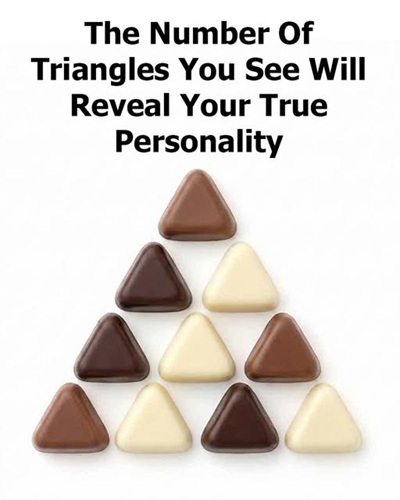
Interestingly, how someone interacts with the triangle puzzle may correlate with certain cognitive tendencies and personality traits:
- Fewer triangles (9 or fewer): These individuals may value clarity, structure, and efficiency. They are practical thinkers, often prioritizing the most immediately relevant information. They may prefer simplicity over complexity and tend to organize tasks and concepts in clear, hierarchical frameworks.
- Moderate triangles (13–16): This group balances logic and imagination, combining analytical reasoning with creative insight. They can shift between global and local processing, adapting their approach as needed. Such individuals are often excellent problem-solvers in contexts that require both structured planning and inventive thinking.
- Many triangles (20+): Observers in this category tend to be highly attuned to nuance, noticing subtle details and non-obvious relationships. This capacity often correlates with divergent thinking, a cognitive style associated with creativity, innovation, and exploring multiple solutions simultaneously. These individuals are comfortable embracing complexity and ambiguity.
It is important to emphasize that none of these approaches is inherently superior. Each represents a different cognitive strength and a unique way of processing visual and conceptual information. The triangle puzzle is not a test with a single “correct” answer; it is a tool for reflection, inviting observers to consider how their perceptual habits shape their interpretation of the world.
Gestalt Principles in Action
The triangle puzzle exemplifies several core Gestalt principles, including:
- Figure-Ground Perception
Our brains automatically distinguish “figure” (the object of attention) from “ground” (the background). In the triangle puzzle, some observers focus on the largest triangle as the dominant figure, while others detect smaller triangles embedded in the ground, resulting in different counts. - Closure
Humans tend to perceive incomplete shapes as complete. In this puzzle, lines that intersect or terminate abruptly may still be perceived as forming a complete triangle, even if no explicit triangle exists. - Proximity and Similarity
The spatial arrangement and coloring of triangles influence how we group them. Clusters of similarly colored or closely spaced triangles may be counted as a single unit by some observers, while others parse each component individually. - Multistability
Just as in the classic “duck-rabbit” or “Necker cube” illusions, the triangle puzzle can appear differently depending on the observer’s focus. The same image may yield multiple interpretations, each valid in its own right.
These principles illustrate that perception is an active, interpretive process rather than a passive recording of visual data. What one person perceives is influenced not only by the image itself but also by cognitive tendencies, attentional priorities, and past experiences.
Applications Beyond Puzzles
The insights gained from the triangle puzzle extend to a wide variety of real-world contexts:
- Education
Teachers can use puzzles like this to assess visual-spatial reasoning and encourage students to approach problems from multiple perspectives. Students who initially see fewer elements can be guided to explore hidden patterns, fostering cognitive flexibility. - Problem-Solving and Innovation
In business and engineering, the ability to shift between global and local perspectives—mirroring how one counts triangles—can enhance strategic planning and creative innovation. Teams that combine individuals with diverse perceptual styles are often more effective at generating solutions that are both practical and inventive. - Art and Design
Artists, architects, and designers often rely on Gestalt principles to create visually compelling compositions. Understanding how viewers perceive shapes and patterns can inform decisions about structure, hierarchy, and emphasis. - Cognitive Training and Mindfulness
Exercises involving visual puzzles can improve attentional control, pattern recognition, and mindfulness, helping individuals train their brains to notice details without losing sight of the larger picture.
The Role of Individual Differences
The triangle puzzle underscores a broader truth: perception is deeply personal. Variations in how people interpret shapes can be influenced by:
- Neurological differences: Brain regions like the parietal and occipital cortices play crucial roles in spatial processing, visual attention, and pattern recognition. Differences in neural connectivity or processing speed can affect how one parses complex images.
- Cultural and educational background: Training in geometry, visual arts, or mathematics can shape attentional habits, leading individuals to notice different configurations.
- Cognitive style and personality: As previously discussed, some people naturally gravitate toward structured, detail-oriented processing, while others embrace creativity, abstraction, and divergent thinking.
These factors combine to ensure that the same puzzle will yield a rich diversity of responses, each reflecting the observer’s unique cognitive and perceptual profile.
Reflections on Perception and Understanding
Ultimately, the triangle puzzle is a reminder that the way we see the world is subjective. There is no single “correct” answer, and attempting to impose one risks overlooking the richness of human perception. Observing how different people interact with the same visual stimulus offers valuable lessons:
- Some people prioritize efficiency and clarity.
- Others balance logic with imagination.
- Some notice subtle patterns and embrace complexity.
Each approach provides insight into cognitive strengths, attentional habits, and reasoning preferences.
Conclusion
The colorful triangle puzzle is more than just an entertaining challenge. It is a microcosm of human cognition, illustrating how perception, attention, reasoning, and creativity interact in unique and individualized ways.
By inviting participants to count triangles, the puzzle encourages reflection on how we process information, organize visual input, and approach problem-solving.
Whether one counts nine triangles or twenty, the value lies not in achieving a single correct answer but in understanding oneself and others. The puzzle encourages curiosity, fosters awareness of cognitive diversity, and demonstrates that multiple perspectives can coexist within a shared reality.
In a world where collaboration, innovation, and insight depend on recognizing the diversity of thought, exercises like the triangle puzzle serve as both a tool and a metaphor.
They remind us that how we perceive the world reflects not only what we see but also who we are, how we think, and how our minds uniquely interpret the complex tapestry of visual and conceptual information around us.
In short, the colorful triangle puzzle is a subtle, elegant reflection of the human mind — inviting us to explore perception, cognition, and creativity one triangle at a time.